Owner’s pay and profit
Gross Commission Income: What You Actually Keep

CEO · Jul 14, 2026
Heidi DeCoux is the founder of Cashflowy, an AI-powered bookkeeping platform, and has worked with thousands of self-employed professionals to simplify finances and improve profitability.

You close a deal. The listing sells for $500,000, your side of the commission is 3%, and the closing statement shows $15,000 in gross commission income. It feels like a good month.
That's until you need to pay the transaction and brokerage fees, marketing, mileage and dues out of the same funds, and you learn the painful truth that much of that impressive commission was never really yours to spend.
By the end of this article, you'll know where that money went and how to pay yourself properly next time. We'll break down the five cuts that stand between gross commission and your actual earnings, and give you a calculator that will instantly show you where you stand with your money.
What is gross commission income?
Gross commission income (GCI) is the income from your sales before deducting costs.
Brokerages usually track GCI to measure agent production. Depending on the brokerage’s compensation model, it may be used to calculate commission splits, monitor progress toward an annual cap and determine eligibility for awards or bonuses. Strong production may also help you negotiate a better split or additional support.
Even though it's important, it tells you almost nothing about your financial health or personal budget.
The gross commission income formula
The calculation is quite simple:
Sale price × commission rate = gross commission income
Like we said at the beginning, a $500,000 purchase with a 3% commission rate makes your GCI $15,000. It works the same for annual planning:
Total sales volume × your average commission rate = annual gross commission
One note on buyer-side transactions: under the practice changes from August 2024, buyer agreements must specify how the agent will be compensated, and offers of buyer-broker compensation can no longer appear on an MLS. A buyer, seller or listing broker may still cover the agreed amount, depending on the transaction. This may change the commission rate or amount used in your calculation, but it doesn't change the basic GCI formula.
Gross commission, net commission and take-home pay are three different numbers
| Number | What it means | Comes after |
|---|---|---|
| Gross commission income | Total commission the deal generates | The deal close |
| Net commission income | Your share after the brokerage | Splits, transaction, franchise and referral fees |
| Actual take-home | Money that funds your life | Business expenses and your tax set-aside |
According to the National Association of REALTORS, the median gross income from real estate activities was $59,200 in 2025, and median annual business expenses were $9,530.
If your GCI grows year over year while your actual financial performance stays the same, analyze where the additional commission is going. Brokerage deductions, transaction fees, operating expenses or taxes may be consuming the increase. That isn’t necessarily a sign of poor performance if you’re deliberately reinvesting in growth, but higher production isn’t yet translating into more personal income.
The five steps between your commission and your bank account
Each commission check goes through the same sequence before you get your real money:
- Gross commission income
- Brokerage splits and fees
- Business expenses
- Tax reserve set aside
- Safe owner's pay
Let's stick to the $15,000 example. Assume a 70/30 split with a $395 transaction fee, monthly business expenses of $1,200, and a 25% reserve on net profit.
| Step | Calculation | Remaining |
|---|---|---|
| Gross commission | Starting point | $15,000 |
| Brokerage split (30%) | −$4,500 | $10,500 |
| Transaction fee | −$395 | $10,105 |
| Business expenses (one month) | −$1,200 | $8,905 |
| Estimated tax set-aside (25%) | −$2,226 | $6,679 |
Your result will depend on your brokerage split, fees, operating costs and tax reserve. Use the calculator below to run the same calculation with your own numbers.
Run your own numbers
If you want to see this with your own numbers without having to do the math, start a free Cashflowy trial. Setup takes only six minutes. Cashflowy is a bookkeeping platform for self-employed professionals that calculates your tax reserve and safe owner’s pay automatically, then keeps those amounts current with commission and cost changes. The calculator is built in to the dashboard and updates in real time.
Your split is only the first cut
You'll notice that the brokerage split is the biggest cut from your commission, so it’s naturally the first cost agents focus on. But this is only part of it and definitely not all you should focus on.
Splits, caps and per-deal fees
Your brokerage agreement determines how each commission is divided. With a 70/30 split, you keep 70%, and the brokerage receives 30%.
| Split structure | Your share of $15,000 |
|---|---|
| 50/50 | $7,500 |
| 70/30 | $10,500 |
| 90/10 | $13,500 |
Some brokerages use the same split throughout the year. Others increase your share after you reach a production target. On the capped model, the brokerage stops taking its percentage after receiving a set amount from you that year. Flat-fee brokerages charge a fixed amount per closing.
Transaction and franchise fees may be deducted from each closing, too, or a referral fee may apply when another agent or brokerage sends you the client, so a 70/30 split doesn’t always leave you with exactly 70% of the GCI.
Your income target also needs to cover business expenses
Your brokerage split and fees determine how much of each commission reaches your business. You still need to pay the costs of running that business before deciding how much you can pay yourself.
Common expenses to factor in include:
- vehicle and mileage,
- marketing,
- signs,
- listing photography,
- staging,
- CRM,
- lead generation,
- MLS dues,
- licensing,
- errors and omissions insurance,
- continuing education,
- paid administrative support.
Some of these add up even when you don’t close a deal, e.g., software subscriptions, insurance and professional dues. Others vary with your activity (mileage, photography, staging and advertising).
Convert annual and recurring costs into a monthly average. Your GCI target must cover those expenses, brokerage deductions and taxes before it can give you the owner’s pay you want.
Set aside taxes before you pay yourself
After brokerage deductions and business expenses, the next amount to account for is tax.
Employees normally have income tax, Social Security and Medicare deducted from each paycheck. However, according to NAR’s latest research, 86% of realtors are independent contractors at their firms, and those generally don’t have these amounts deducted. In that case, you're responsible for setting aside money for federal income tax, self-employment tax and any applicable state or local taxes.
Move your estimated tax amount into a separate reserve before calculating what you can pay yourself.
Calculate your tax set-aside from business profit
A typical reserve recommendation is 25%-30% of business profit, but in reality it depends on your total income, filing status, state, deductions, credits, and any tax already withheld elsewhere.
Subtract eligible business expenses from the commission you keep after brokerage deductions. The result is your business profit. Don’t calculate the reserve from GCI because it includes money paid to the brokerage and doesn’t account for deductible operating costs. Using net commission before expenses would mean setting aside more than necessary.
Note that this calculation is for cash planning purposes, and isn't a complete tax deduction. Self-employed agents may owe federal income tax and self-employment tax (the Social Security and Medicare contributions normally divided between an employee and employer). Use Form 1040-ES or work with a tax professional to estimate the amount more accurately.
Once you calculate the tax set-aside, move that amount into a dedicated tax account. Keep it in a separate savings account or business subaccount used only for taxes.
Cashflowy tracks the amount allocated to your taxes as income and expenses are recorded. You can compare that figure with the balance in your tax account and correct any difference before the next estimated payment is due.
How to manage your money between closings
Once you’ve accounted for business expenses and taxes, decide how to use the remaining money until more commissions arrive. You can pay yourself on a regular schedule or take irregular draws.
Option 1: Pay yourself a regular amount
Review the owner’s pay available from the last year and divide it by 12 to get a monthly average. This is the basic approach the Federal Trade Commission recommends. Set your transfer below that average if your pipeline has weakened or your recent income was unusually high.
Transfer the amount monthly. Leave the extra cash from stronger months in the business so it can support the same transfer during quieter periods.
Option 2: Take money out after each closing
If you're fine with irregular transfers, you can calculate the maximum available draw from each commission:
Available owner’s draw = unrestricted business cash − upcoming expenses − tax reserve − operating buffer
Only use money already received; don’t include pending commissions because closing dates can move.
Then decide how long the draw must last. In the earlier example, the available owner’s pay was $6,679. If it needs to cover two months, that gives you approximately $3,340 per month. If it needs to last three months, the monthly amount is about $2,226.
You can also move the full draw into a separate personal holding account, then transfer one month’s budget into your checking account at a time. The business payment remains irregular, but your personal spending becomes easier to control.
Whichever method you choose:
- Create a 90-day cash salary calendar showing expected closings, business bills, tax payments and personal payment dates.
- Divide annual costs such as licensing, insurance and MLS dues by 12, then reserve that amount each month.
- Keep a minimum operating buffer based on your essential business expenses and the typical gap between closings. Three months is a good starting point.
- Take an extra draw if you need to, but only after upcoming expenses, taxes and your minimum buffer are covered.
- Recalculate after a major change in your split, expenses, pipeline or personal budget.
Work backward from the income you want to keep
Once you know how each commission is divided, you can use the same calculation to set an annual GCI target.
- Set your annual take-home target.
- Divide it by one minus your estimated tax reserve rate.
- Add your expected annual business expenses and fees.
- Divide by the share of GCI you retain after the brokerage split.
- Divide the required GCI by your average GCI per closing to estimate how many deals you need. Always round up.
For example, assume you want $60,000 as your base salary, reserve 25% of business profit for taxes, spend $15,000 annually and retain 70% of GCI:
($60,000 ÷ 75% + $15,000) ÷ 70% = approximately $136,000 in required GCI
| Take-home target | Required GCI | Closings at $15,000 average GCI |
|---|---|---|
| $60,000 | ~$136,000 | 10 |
| $100,000 | ~$212,000 | 15 |
| $150,000 | ~$307,000 | 21 |
These examples assume a 70/30 split, a 25% tax reserve and $15,000 in total annual business expenses.
If your split changes after you reach a cap, don’t use one percentage for the entire year. Calculate the GCI required before and after the cap separately, or use your effective retention rate from the previous year:
Effective retention rate = commission kept after brokerage deductions ÷ total GCI
Keep the numbers current as the year changes
Working backward gives you an annual target, but the inputs won’t stay fixed. Every closing changes your revenue, every new expense changes your profit and reaching your brokerage cap changes how much commission you keep. A spreadsheet can track all this, but only if you enter every transaction and keep the formulas current.
Cashflowy applies the same calculations to your actual account activity. It’s built for solo professionals, including real estate agents. After connecting your accounts, it pulls in transactions automatically and keeps your profit, estimated tax set-aside, safe owner’s pay and 90-day cash flow forecast updated.
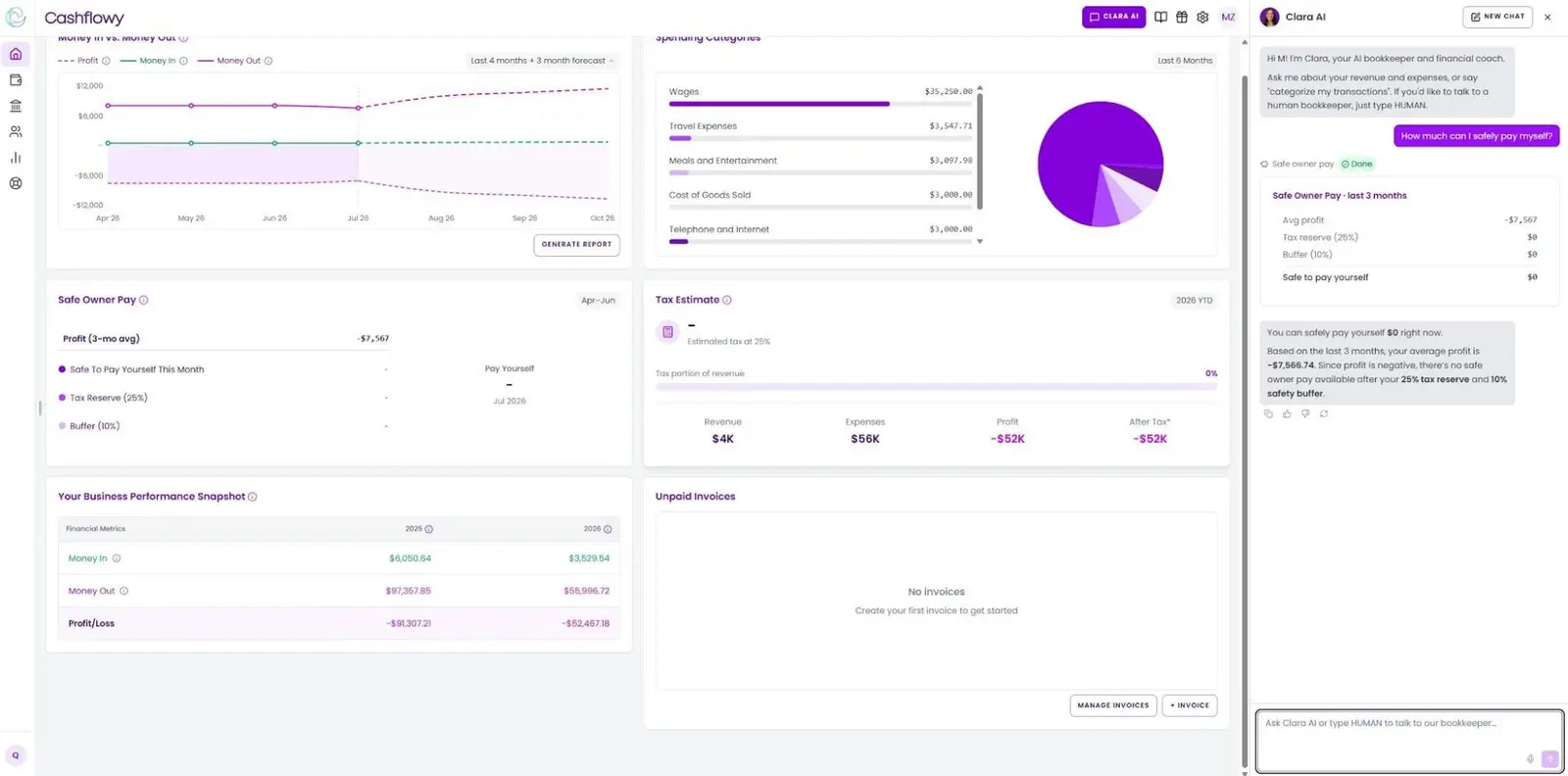
That means you don’t need to repeat the calculation from this guide after every closing. Cashflowy accounts for your revenue, expenses, tax allocation, upcoming bills and buffer when showing how much is currently available as owner’s pay. The forecast also helps you see whether a quiet period or upcoming expenses could leave you dry.
If you want more detail behind a number or help with money-related decisions, you can ask Cashflowy questions such as “How much can I safely pay myself this month?” or “Where did my expenses increase?” She uses data from your connected accounts to answer.
Access to a human bookkeeper is included at no additional charge through chat and support calls. Account setup takes about six minutes, with supported connections to over 12,000 financial institutions.
Start your trial to try it free. Takes 6 minutes to set up and see your numbers. Cancel any time.
GCI measures production. Owner’s pay measures the outcome
Your brokerage tracks GCI because it shows production, and you should track it for the same reason. What GCI can’t tell you is whether those commissions are covering your operating costs, building your tax reserve and leaving enough cash for you between closings.
That requires a second number: the amount safely available after brokerage deductions, business expenses, estimated taxes and your operating buffer. Tracking both helps you see whether you need more closings, lower expenses, a different brokerage arrangement or simply a more disciplined way to manage irregular income.
Use the calculator to break down one closing with your own numbers. If you want that calculation to update as commissions and expenses arrive, start a free Cashflowy trial and see how to ensure your business is always profitable.